
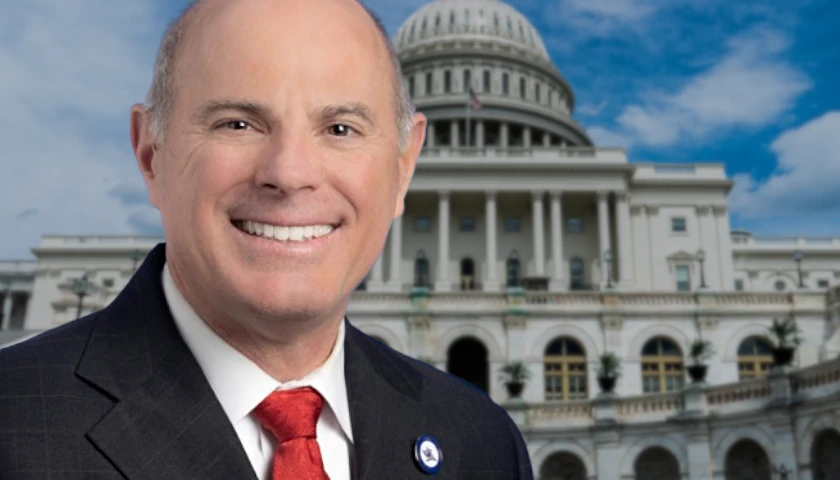
State Representative Gino Bulso (R-Brentwood), after officially announcing his candidacy in the Republican primary for Tennessee’s 7th Congressional District, told The Tennessee Star’s CEO and Editor-in-Chief Michael Patrick Leahy in an exclusive interview that if elected to Congress, he would focus on addressing the nation’s $37 trillion national debt.
On Monday, Bulso announced his candidacy for Congress, touting his record in the Tennessee General Assembly as a “proven” conservative legislator with a record of passing and supporting “a host of bills that reflect the Trump-era priorities voters continue to demand.”
“I’m running for Congress because we need proven conservatives who get results. I’ll take the fight for medical freedom, secure borders, balanced budgets, and parental rights straight to Washington, just as I have done in Nashville,” Bulso said upon launching his congressional campaign.
Bulso(pictured above), during Monday’s edition of The Michael Patrick Leahy Show, said his primary focus if he were to be elected to Congress would be tackling the national debt.
“[The debt] is becoming something that has to be addressed. There no longer is time to delay, and we need to get the public’s attention riveted on it because of the long-term effects of it. We’ve got approximately $37 trillion in debt right now, and we’re racking it up at a rate of more than $1 trillion every year,” Bulso explained.
“It is not sustainable. It needs to change,” he added. “I’m going to go [to D.C.] with the principal focus of leading the fight to do what needs to be done to reform entitlement so that we can actually get the out-of-control spending back within the bounds that the founders intended.”
Noting that approximately 80 percent of the federal budget is already committed through entitlements and mandatory spending, Bulso emphasized the debt was neither caused by Social Security nor Medicare, but rather created through mismanagement and a failure to reform these programs.
He proposed reforming entitlement programs as one way to address the national debt, explaining how one of his central ideas is to raise the Social Security retirement age for future generations, pointing out that when Social Security was established, the average life expectancy in the U.S. was around 61 years, while today it exceeds 78.
Bulso said he draws inspiration for his proposals to tackle the national debt from past congressional efforts to rein in federal spending, particularly the work done by the Bipartisan Commission on Entitlement Reform in the 1990s. This commission, among other proposals, suggested raising the eligibility age for full retirement benefits to reflect increased life expectancies.
“Neither Social Security nor Medicare, which was put in place in 1965, caused a debt crisis. It’s been the problem and the failure to manage those programs, and to have politicians actually do what needs to be done to be good stewards of taxpayers funds with regard to those and other programs. One idea that you may recall from the bipartisan commission was to look at the fact that when social security was created, that the average life expectancy of a US citizen was 61 years. There was not a lot going out,” Bulso explained.
Bulso stated adjusting the retirement age can make the program more financially viable over the long term.
“Obviously, [life expectancy] is now over 78 years, so raising the age for future generations – not for anyone who’s currently close to or going to be receiving entitlement benefits under Social Security – at which someone becomes eligible to recover those funds,” he added.
In addition to entitlement reform, Bulso said he also supports measures to reduce unnecessary or excessive government benefits, starting with those enjoyed by elected officials themselves through congressional pensions.
“Looking at other things, like congressional pensions, for example, because I think there are other areas that everyone needs to share to some extent in exactly what needs to be done to reduce federal spending. That’s also something that was pointed out in the bipartisan report from the 1990s,” he said.
Bulso also stressed that no lasting reform can happen without public support, saying he believes that building a national consensus around the urgency of the debt crisis is essential.
“Although leadership is important, the public is even more important. As a student of history, you know that when Abraham Lincoln was debating in 1858 with his congressional debates against Douglas, he said, among other things, ‘Public sentiment is everything. With it, nothing can fail; against it, nothing can succeed.’ So the trick here is not just getting leadership on the side of doing what needs to be done to get spending under control, the trick is to get the public behind you,” Bulso said.
“One of the things that Thomas Jefferson was famous for saying was that ‘It is incumbent on every generation to pay its own debts.’ I don’t think anyone, certainly no conservative, is comfortable with the idea that we are passing on to our children and grandchildren a $37 trillion deficit,” he added.
Regarding campaigning and engaging with individuals across the 7th District, Bulso said most voters share a deep love for the country and many respond positively to his focus on restoring the government to its intended structure.
“Most folks that I come across, they just love their country. They’re patriotic and they actually want to have the type of government that the founders intended,” Bulso said.
“Folks, I think, really have an appreciation and a love for the history of our country and for the blueprint that is the U.S. Constitution, so when I connect with them on the fact that we need to get back to the type of government that our founders intended, they respond overwhelmingly in a favorable way,” he added.
When asked if concerns differ between urban, suburban, and rural parts of the 7th District, Bulso said they do not, explaining how voters across the district value the sanctity of life, Second Amendment rights, limited government, and are frustrated with career politicians.
He expressed his support for congressional term limits, referencing Alexis de Tocqueville’s warning in the book Democracy in America that American democracy would falter once politicians learned they could use public funds to buy votes.
“I am a proponent, given where we are, of term limits for members of Congress because what we have seen has really just been a verification of what Alexis de Tocqueville wrote…which was that American democracy will succeed only until politicians discover that they can bribe the people with their own money. And let me tell you, the politicians have figured that out,” Bulso said.
Calling for a renewed “revolutionary spirit” to take back the federal government and reduce its size and influence in line with the Constitution, Bulso acknowledged how candidates running for the 7th District are going to need to raise at least $500,000 in donations to stand out as competitive candidates in the race.
“I am committed to do whatever is necessary to win the race,” he explained
“Obviously, when you can generate contributions from voters, it actually not only helps you get your message out, but it shows that you have support in the community. The first thing that we’ll be doing…is to be calling out to voters in the district and getting support, both moral support and financial support, from those that we’ve already made some contacts with and, to the extent that there’s a need to, supplement those donations with personal funds,” Bulso said.
The Republican primary in the special election to fill the seat for Tennessee’s 7th Congressional District will take place on Tuesday, October 7.
– – –
Kaitlin Housler is a reporter at The Tennessee Star and The Star News Network. Follow Kaitlin on X / Twitter.




If he knew he would serve only one term if he were to make debt reduction his number one priority and continually shame anyone in Congress who wouldn’t agree to vote to reduce the debt would he do so?